
ANTARANGA
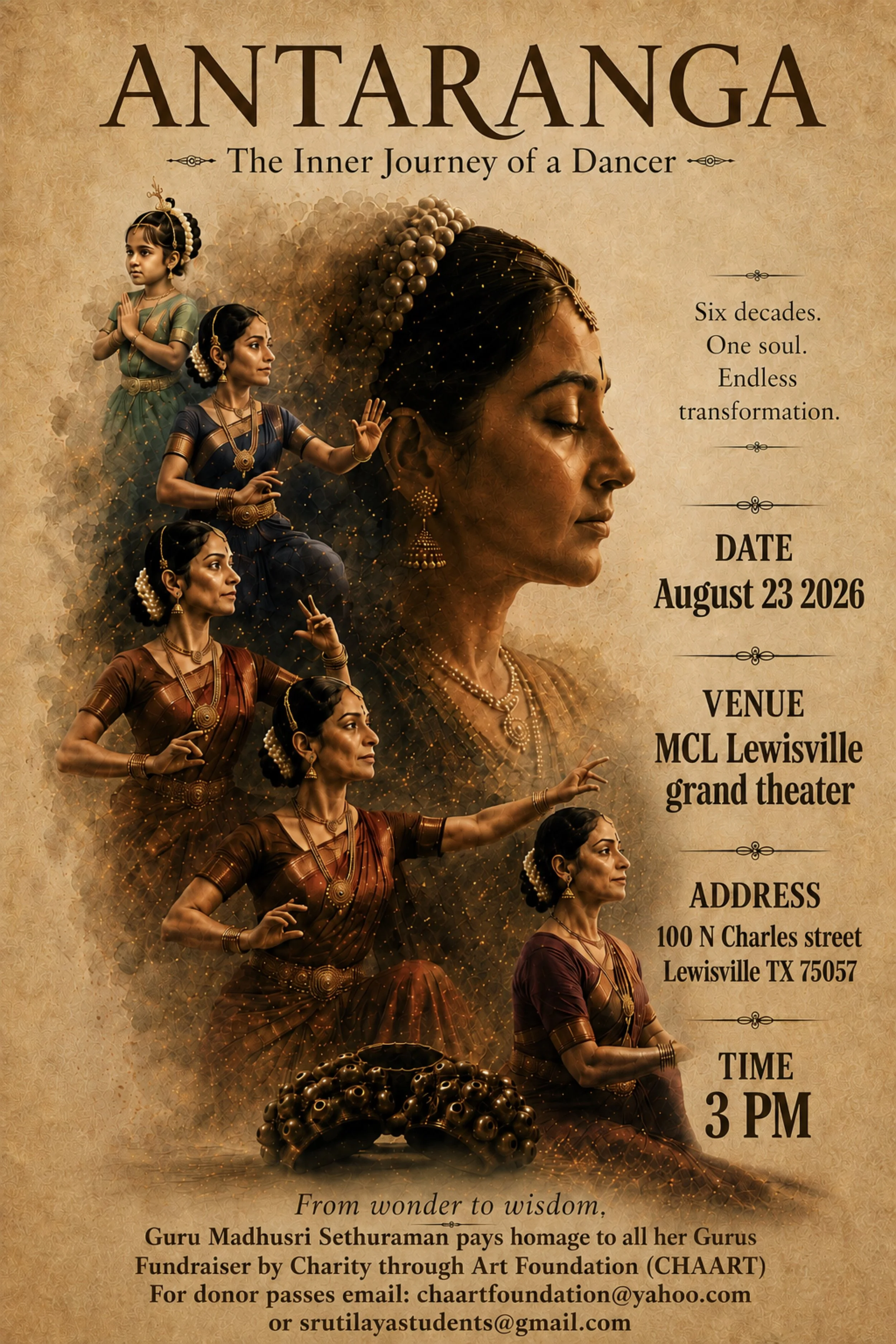
ANTARANGA
A Dance Recital by Srutilaya Dance School
There are performances that entertain, performances that inspire, and then there are those rare artistic experiences that invite us to look inward.
ANTARANGA, presented by Srutilaya Dance School under the artistic vision of Natya Tharagi, Natya Mayuri Madhusri Sethuraman, was one such journey.
The word Antaranga means “the inner world.” True to its name, the production explored Bharatanatyam not simply as a performing art, but as a living tradition passed from guru to disciple and, ultimately, as a deeply personal path of discovery.
The recital unfolded in two distinct yet beautifully connected halves. The first looked backward with gratitude, honoring the gurus who shaped Madhusri Sethuraman’s artistic journey. The second turned inward, exploring a dancer’s evolving relationship with the art through the metaphor of the four seasons — Spring, Summer, Fall, and Winter.
Honoring the Guru-Shishya Parampara
At the heart of Indian classical dance is the Guru-Shishya Parampara — the tradition through which knowledge, technique, values, discipline, and artistic interpretation are carried from one generation to the next.
The first half of Antaranga was Guru Madhusri Sethuraman’s heartfelt homage to three legendary teachers who profoundly influenced her artistic journey:
Padmabhushan Srimathi Kamala,
Kalaimamani Sri S.K. Rajarathnam Pillai, and
Padmabhushan Srimathi Kalanidhi Narayanan.
Rather than honoring them only through words, Madhusri chose something far more meaningful: she brought their teachings back to the stage.
Pushpanjali – Thathodagatham
The recital began with the traditional offering of a Pushpanjali, where dancers seek the blessings of the divine, their gurus, and the audience before beginning their performance.
Thathodagatham, a beloved Pushpanjali in the Vazhuvoor tradition, was originally taught to Madhusri by Kalaimamani Sri S.K. Rajarathnam Pillai. Set in Gambira Nattai and Adi Talam, the piece established the central theme of the evening — gratitude.
Chokkanadhar Kauthuvam
The dancers then invoked Lord Shiva through Chokkanadhar Kauthuvam.
Kauthuvams combine energetic rhythmic syllables with devotional poetry and have deep roots in temple dance traditions. This composition, set in Ragamalika and Adi Talam, was another tribute to Sri S.K. Rajarathnam Pillai.
Through rhythm, movement, and devotion, the dancers transformed the stage into a space of reverence.
Mandooka Shabdam
The recital then entered the world of storytelling with Mandooka Shabdam, composed by Melattur Bharatham Kasinatha Kavi.
Through vivid imagery, rhythmic passages, and expressive storytelling, the piece recounts Gajendra Moksham, the story of Lord Vishnu rescuing the elephant king Gajendra from a crocodile while the frogs surrounding the pond sing his praises.
The performance carried a particularly personal connection: Madhusri herself had performed this piece during her own Arangetram under Padmabhushan Srimathi Kamala.
Years later, watching the work return to the stage through another generation of dancers created a beautiful reminder of how classical art survives — not merely through preservation, but through transmission.
Bhavayami — When the Guru Becomes the Performer
The centerpiece of the first half was Bhavayami, Maharaja Swathi Thirunal’s celebrated composition depicting the story of the Ramayana.
From the birth of Lord Rama and his marriage to Sita, through exile, the meeting with Hanuman, the journey to Lanka, the defeat of Ravana, the rescue of Sita, and finally Rama’s coronation, an entire epic unfolds within a single composition.
But there was another story unfolding on stage.
Guru Madhusri Sethuraman herself joined her students in performing the Varnam.
The moment beautifully captured the essence of the Guru-Shishya relationship. The teacher was no longer only guiding from the side of the stage; she became a fellow dancer, sharing the same space, rhythm, story, and artistic tradition with her students.
Adding another layer of meaning, Bhavayami had also been part of Madhusri’s own Arangetram under Guru Kamala.
A work once passed from guru to disciple was now being passed forward again.
Two Women, Two Perspectives
The program then moved from the grandeur of the Ramayana into the intimate emotional world of abhinaya.
Two contrasting compositions — Ethanai Sonnalum and the Javali Smarasundaranguni — explored two very different women and their relationships with love.
In Ethanai Sonnalum, an exasperated mother advises a daughter who has left her husband following a quarrel. The heroine represents the Kalahantarita Nayika, separated from her beloved because of conflict or misunderstanding.
Smarasundaranguni, in contrast, portrays the confidence of the Swadhina-patika Nayika, a woman secure in her beloved’s devotion and proudly describing his affection for her.
These nuanced explorations of emotion were dedicated to Madhusri’s Abhinaya Guru, Padmabhushan Srimathi Kalanidhi Narayanan, whose influence on the expressive dimension of Bharatanatyam continues through generations of dancers.
Bo Shambho and the Joy of the Thillana
The devotional energy returned with Bo Shambho, a powerful hymn to Lord Shiva.
Set in Revathy and Adi Talam, the composition celebrates Shiva as the eternal, formless supreme being, the presence residing within the devotee’s heart, and Nataraja — the cosmic dancer.
The piece was originally choreographed by Sri S.K. Rajarathnam Pillai and was performed as another loving tribute to Madhusri’s guru.
The first half then reached its joyous conclusion with Tha Tha Dheem, the celebrated Thillana composed by violin maestro Sri Lalgudi Jayaraman, set in Madhuvanti and Adi Talam.
Fast rhythmic passages, intricate footwork, sculptural poses, and the sheer joy of movement brought the homage to an energetic close.
The first half had looked toward the past.
The second asked a very different question:
What happens inside a dancer as the years pass?
ANTARANGA — The Inner Journey of a Dancer
For the second half, Bharatanatyam became a language through which the inner life of an artist could be explored.
The dancer’s journey was imagined through the changing seasons:
Spring — Discovery
Summer — Discipline and Struggle
Fall — Transformation and Acceptance
Winter — Introspection
Together, the seasons reflected something that extends far beyond dance — the way our motivations, insecurities, ambitions, and understanding of ourselves change as we grow.
Spring — The Joy of Beginning
Spring represents curiosity, innocence, and possibility.
It is the young dancer entering Bharatanatyam for the first time — discovering rhythm, movement, expression, music, and storytelling.
Through foundational movement and the colorful world of a Meera Bhajan celebrating Holi, the dancers captured the excitement of discovering both nritta, pure dance, and abhinaya, expression.
At this stage, dance is uncomplicated.
There is excitement in learning a new step. Joy in successfully completing a sequence. Wonder in discovering that a gesture, glance, or expression can tell an entire story.
Everything feels possible.
But every spring eventually becomes summer.
Summer — Discipline, Growth and Doubt
Summer represented the demanding years of training.
Through exercises and a Trikala Jathi performed in three speeds, the choreography revealed what audiences rarely see behind a polished performance: repetition, physical discipline, corrections, perseverance, and countless hours spent refining technique.
Yet the struggle of an artist is not purely physical.
As dancers mature, comparison begins.
Am I talented enough?
Do I look like a dancer should?
Why does someone else seem to progress faster?
Can I hold an audience’s attention?
The production gave those private insecurities a place on stage, portraying dancers competing not only with one another, but also with the voices inside themselves.
It was an important reminder that artistic growth rarely follows a straight line. Technique may improve even while confidence falters.
And sometimes the greatest battle takes place entirely within.
Fall — Transformation and Acceptance
Fall brought transformation.
After years of training, struggle, comparison, and self-doubt, the dancer begins to understand herself differently.
Through Shuddha Nrittam, the performers returned to pure movement, but now with maturity behind every step.
The dancer gradually stops measuring herself against everyone around her. She begins recognizing her own strengths and accepting the body, experiences, and artistic voice that belong uniquely to her.
The accompanying abhinaya turned the journey inward.
Looking back, she begins to understand that the difficulties she once resisted were also her teachers.
Pain taught patience.
Practice taught discipline.
Failure taught persistence.
And the stern corrections of the guru, once difficult to accept, become understood as acts that helped shape the artist.
Eventually, the dancer sees her body differently as well — not merely as an instrument expected to execute technique perfectly, but as a temple through which the art itself can live.
Winter — When Dance Becomes Something More
Winter was perhaps the most introspective chapter of Antaranga.
The dancer is older now.
The applause, reviews, recognition, competition, hierarchy, and validation that once seemed so important begin to lose their power.
She looks back and confronts an uncomfortable realization: how much of her artistic life was spent asking the outside world to confirm her worth?
There is anger in that realization.
There is also grief.
But beneath both comes clarity.
The dancer finally understands that dance was never meant simply to make others see her.
It was meant to help her see within herself.
What began as movement becomes meditation. What began as performance becomes a spiritual pursuit.
The journey becomes that of the Jeevatma, the individual soul, seeking the Paramatma, the divine.
And suddenly the title Antaranga reveals its deepest meaning.
The dancer has spent years learning how to perform outwardly, only to discover that the destination was inward all along.
A Circle Completed
There was something especially meaningful about the structure of Antaranga.
The afternoon began with a teacher remembering her own gurus.
We saw compositions that Madhusri herself had once learned and performed as a student. We then watched those traditions continue through her own students.
And finally, we entered the inner world of the dancer herself — moving beyond technique and performance toward questions of identity, purpose, gratitude, and spirituality.
That creates a beautiful circle:
Guru to student. Student to artist. Artist to guru. And guru to the next generation.
The steps may belong to an ancient tradition, but every dancer must eventually discover what those steps mean within their own life.
That is perhaps the true beauty of Antaranga.
The Artists Behind the Production
The artistic vision, dance choreography, and nattuvangam for Antaranga were led by Natya Tharagi, Natya Mayuri Madhusri Sethuraman, with nattuvangam support from Anushka Kumar and Isiri Datta.
The dancers were supported by a live orchestra whose music gave life and emotional depth to the production:
Vocals: Neela Ramanuja
Mridangam: Pramath Kiran
Flute: Krishna Prasad
Rhythm Pad: Pranav Dutt
And, of course, at the center of the production were the many students of Srutilaya Dance School, representing different stages of the very journey Antaranga sought to portray.
More Than a Dance Recital
Antaranga was ultimately about much more than Bharatanatyam.
It was about gratitude for those who teach us.
It was about the innocence with which we begin, the discipline required to grow, the insecurities we encounter, and the acceptance that comes with experience.
Most importantly, it asked artists to reconsider where they seek validation.
Applause eventually fades. Reviews are forgotten. Recognition changes.
But the relationship between an artist and the art can continue to deepen.
Perhaps that is the journey every artist eventually makes — from wanting the world to see what they can do, to discovering what their art allows them to see within themselves.
That inner space is Antaranga.